Proverbs 8:1-4, 22-31; Romans 5:1-5; John 16:12-15
There is a story about a individual who was approached by a traveling evangelist who earnestly asked if the person had found Jesus. The person answered with all sincerity, “No. I didn’t know he was lost.”
Our theology is filled with the struggle to answer the question about relating to God. Do we seek and find God or does God seek and find us? In truth it is probably both. The psalmist says, “I raise my eyes toward the mountains. / Where will my help come from?” The psalmist answers his own question by saying that his help “comes from the Lord” (Psalm 121:1), and apparently not the hills. In another psalm, the psalmist can’t run away from God. “Where could I go to get away from your spirit? / Where could I go to escape your presence?” And the answer is: nowhere (Psalm 139:7-12).
On other occasions, God seeks. After Adam and Eve discover that they have a wardrobe malfunction, they hide from God. God calls out, “Where are you?” (Genesis 3:9). After Cain kills his brother Abel, God asks Cain, “Where is your brother?” (Genesis 4:9). Jesus sought our Peter and Andrew and James and John as he was collecting disciples. He invited himself to Zacchaeus’ house for lunch. And he sought out the Pharisee Saul on the road outside Damascus.
The reality is that sometimes God is looking for us and sometimes we are looking for God. But as the psalmist suggested, if we can’t get away from God, then what is absent is not God but our awareness of God.
This is Trinity Sunday, our annual attempt to think equally about the three persons of the Godhead: Father, Son, and Spirit. It’s hard to do, for most of us have an affinity for one of the three faces, as it were, of God. Most all of us drift into a heavier relationship with the Father or with the Son or with the Spirit. It’s hard not to. After all, we see creation, but not the Creator. Jesus said that no one has seen the Father except the Son. And the Son is the Word made flesh and blood. Jesus also told us that no one sees the wind, only the effects of it. That’s how the Spirit operates. Believers with a mystical bent understand the Trinity as a dance among the three persons. And it’s one of those dances where the dancers are whirling so fast that it is a blur. None of the three are identifiable at any given point. Yet the dance is a magnificent spectacle for the senses.
This dance is really an invitation. Not a fancy engraved invitation requiring an equally formal response, but a heartfelt, passionate beckoning, like the once romantic scene of a lover standing in the doorway of departing train car beckoning her lover to join her while there is still time for him to catch the train. She calls out, “Come away with me!”
We may not know that poignant love scene, but we are all to familiar with voices calling out to us. After all, this is an election year. And while the fields have narrowed, the voices beckoning our attention, our curiosity, our support, our votes are not getting softer and more coaxing. They are becoming more strident, more caustic, more bull-hornish. And we still have more than five months to endure it before the vote is taken and the next four-year cycle begins its crescendo.
On a more friendly note, a circus midway comes to mind. There are the all the amusement booths with their barkers: “See the tallest man on earth.” “See the bearded lady,” “Step this way to the greatest show of exotic flora and fauna under one tent.” “Throw the ball and knock the milk bottles over; win a prize.” “See the masked bamboozler swallow not one, not two, but five flaming swords.” And so on and so on.
That is the image the collector of Proverbs has given us. The reading begins with the image of Lady (or Teacher) Wisdom standing up and hollering an invitation for us to come to her, just like the circus barkers or politicians do. Madam Wisdom cries out “atop the heights along the path, at the crossroads...by the gate before the city.” Like the ever-present prescription medication or political ads, Wisdom seems to show up everywhere, expected or not. What is she doing? She is beckoning us to something infinitely better than the seductive invitation which was offered in the previous chapter.
If you haven’t read Proverbs 7 recently, do so, knowing that it is at least “R-rated.” The invitation there is that of a vamp, a hooker, a street walker. And it doesn’t take a whole lot of imagination to know where that liaison will take a person.
While the invitation of the seductress may have its thrill and immediate and short-lived gratification, the blessing that Wisdom offers is for the long-term.
In the verses that were omitted in the reading, Wisdom admonishes her hearers to acquire for themselves prudence, intelligence, instruction, and wisdom. Those are lasting blessings for any person. When we pick up the reading again, Wisdom is again speaking out to the crowds, enticing them to listen to her. She is establishing her credentials. Wisdom isn’t ashamed to admit how old she is. She literally is “older than dirt” to borrow a popular expression. She came into being before everything else.
The Lord created me at the beginning of his way, before his deeds long in the past. I was formed in ancient times, at the beginning, before the earth was. When there were no watery depths, I was brought forth, when there were no springs flowing with water. Before the mountains were settled, before the hills, I was brought forth; before God made the earth and the fields or the first of the dry land.
The Hebrew verb for “brought forth” may also be translated as “whirl, dance, or writhe.” We are back to the image I suggested earlier to describe the interaction of the Trinity. If that isn’t enough, in verse 30 Wisdom says of her time with God at creation, “I was beside him as a master of crafts.” In essence, Wisdom says, “I am not a Jill-Come-Lately. You can trust me. After all, I have been with God from the very beginning. In fact, I was God’s helper, working right beside the Creator. My references are impeccable. Listen when I speak.”(1)
So Wisdom was part of creation’s architectural team, just as John described Jesus in the gospel prologue: “The Word was with God in the beginning. Everything came into being through the Word, and without the Word nothing came into being” (John 1:2-3).
At the close of the passage, Wisdom shouts one more claim that knocks our socks off:
“I was having fun, smiling before him all the time, frolicking with his inhabited earth and delighting in the human race.”
That’s not the picture of Wisdom that usually comes to mind. When we say the word “wisdom,” don’t we often imagine a stern, pursed-lipped person, a killjoy, or a solemn judge in black robe? That definitely is not the picture of wisdom here. Wisdom is not dour drudgery; Wisdom is joyous laughter, dance, and play.(2) And what’s more, Wisdom rejoices in us, in humanity – you, me, all of us, the ones who have long since come and gone and the ones yet to come.
Wisdom sounds like the kind of person you would want to hang out with, stop in to Starbucks for a cocoa double latte, extra cinnamon. And Wisdom might appreciate it if we followed her on Twitter and retweeted her posts.
Imagine this scenario:
I was out shopping yesterday, and whom did I run into? Wisdom. Yeah, there she was. She called me over and we began talking, Wisdom and I. Then, I went down to the courthouse, and there she was again, making a plea for justice in a courtroom where somebody had been unjustly accused. After that, I dropped by the school, and she had gotten there before me, She was calling for students and teachers alike always to seek truth. Then I went for a walk in the woods, moving along the trail in quiet meditation. Wisdom snuck up on me and said, “Now that we are alone, I have something I want to share with you, a present I want you to enjoy. You know, I have been around a long time, really before the beginning of time. I have been whirling and dancing with God all along. I am God's delight, laughing and playing. I want you to know the lightness of spirit and gladness that come when you welcome me. Will you set aside those thoughts, words, and deeds that make life heavy and sad for you and others? Will you come and laugh and play with me? Will you come and dance with me? Will you?”(3)
Don’t you think we need to lighten up and stop making our God into something that God isn’t. We do not worship a stingy God who grudgingly gives gifts and who grants forgiveness as a divine grump. Not at all. The triune God – God in Community, Holy in One – is a joyous, dancing God who pours out overflowing gifts to humanity with gladness.
With all her beauty and grace, Wisdom invites us all to walk, laugh, play, and dance into the light of God’s new day. Let’s not be wallflowers. Let’s accept the invitation to God’s dance.
Alleluia!
(1) Jeff Paschal, “Homiletical Perspective,” Feasting on the Word: Preaching the Revised Common Lectionary (Louisville: Westminster John Knox Press, 2010), Year C, vol. 3, 27.
(2) Ibid., 29.
(3) Ibid.
Unless noted otherwise, all scripture references are from The Common English Bible, © 2011 www.commonenglishbible.com.
Copyright © 2016 First Presbyterian Church of Waverly, Ohio. Reprinted by permission.
Romans 8:14-17; John 14: 8-17; Acts 2:1-21
Queen Elizabeth II of the United Kingdom has two birthdays: her date of birth – April 21st – and the official holiday marking her birth, usually the second Saturday in June. She had a grand 90th birthday several weeks ago.
The church isn’t all that different from the Queen. It has two birthdays. We don’t really know when the church was birthed. Theologians will offer a variety of possibilities for that. But we have the official birthday – today, the Day of Pentecost – which marks the giving of the Holy Spirit to the apostles. And what a party that was, right there in the middle of Jerusalem. Hijinks and hilarity, celebratory toasts in a multitude of languages, and sheer unadulterated amazement.
I don’t think that they had cake and ice cream, but they did have gifts. In some cultures it is the birthday person who gives the gifts. In a lot of children’s parties today, there are little gift bags for each one attending. But of course there are the gifts for the natal honoree.
The Holy Spirit seems to serve as both attendees’ gifts and as the gift for the center of attention, in this case the nascent church. That’s because the people who were there – apostles, hangers on, and bystanders alike – were the church in that creation moment.
What was really wonderful was that the gifts of the Holy Spirit were tailored with each recipient in mind. You heard the list, They range from Rome in the west to Iran in the east, from the Black Sea in the north to the southern shore of the Mediterranean Sea and the Arabian peninsula and everywhere in between, including the local Judean community. What a mixture of people. They may have been visitors, but when they returned home did they ever have a story to tell.
All those Pentecost tongues of fire represent gifts of the Spirit. Those gifts are among the earliest treasures of the church. You won’t find them in shrines or museums. They won’t be in arks and reliquaries found in ancient churches. These treasures are all around us.
On Pentecost Sunday we celebrate what it means to become God’s heirs, joint heirs with Christ, inspirited expressions of God’s handiwork, and curators of the treasures of the church. God’s creative energy is once again poured out and passed on to the world, transforming it and redeeming it. All those “led by the Spirit” are swept up in this new burst of creativity. Who cannot be changed forever by an encounter with this spirit of adoption?
The church has bequeathed to each succeeding generation a growing collection of treasures. Some are ancient, as in the Roman catacombs. Others are Medieval, or Renaissance, or classical. Others are contemporary. Any cathedral or world class museum may have them. But some of them may be found in less impressive places. I remember being awash with rococo art in Bavaria and Austria and then pleasantly surprised by a simple, almost primitive folk art mural in a small parish church the size of our building.
To start to discover the church’s treasures, a person needs to go to what started out as the private art collection of the Tsars, but today is known as The State Hermitage in St. Petersburg, Russia. It has three million art works on display making it, some believe,“The World’s Greatest Museum.”
There are 24 Rembrandts in the Hermitage. Many people think that “The Return of the Prodigal Son,” which dates from the last tragic years of the artist, is the best of them all. It was Henri Nouwen’s favorite painting, and the basis for his book The Prodigal Son.
In an essay on Rembrandt, Georg Simmel claims that “for the first time in the history of art,” Rembrandt portrays the piety of the soul, not the religion of the church, and in this painting “people are no longer in an objectively religious world; they are subjectively religious in an objectively indifferent world.” Rembrandt's unique achievement, says Simmel, is that “he has captured the religious mood and sense of grandeur as the general element of his works, with light as the visual agent of this generality.” (1)
One personal favorite is Salvador Dali’s 1951 “Christ of Saint John of the Cross,” which hangs in the Glasgow Art Museum. It is the most popular of all Dali's religious works. The figure of the crucified Christ dominates the Bay of Port Lligat. The painting was inspired by a drawing, preserved in the Convent of the Incarnation in Avila, Spain, and done by the mystic Saint John of the Cross himself after he had seen this vision of Christ during an ecstasy. Dali wrote in 1951, “I had a ‘cosmic dream’ in which I saw this image in color and which in my dream represented the ‘nucleus of the atom’. This nucleus later took on a metaphysical sense; I considered in ‘the very unity of the universe’, the Christ!” (2)

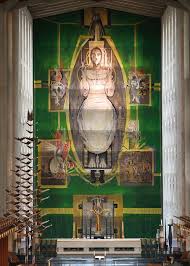
Another personal favorite is the “Christ of Glory,” the great tapestry that forms the climactic focus of the interior of the Coventry Cathedral, designed by Graham Sutherland. It features an enormous seated Christ surrounded by the four beings from the vision of Ezekiel, also symbolizing the Four Evangelists, the angel, eagle, winged Ox and winged lion. The tapestry also includes a Crucifixion at its base which serves as the backdrop for the chapel behind the main altar.
But wait a minute!
Are these really the greatest treasures in the history of the Christian church? You don't have to go to The State Hermitage, Glasgow, Coventry, or any other museum to view the greatest art treasures in the history of the church. Pentecost Sunday proclaims that if you want to see the church’s greatest art treasures, GO HOME. STAY HOME. Look all around you. Open your eyes to the acts of service, the acts of grace, the acts of compassion going on all around you by heirs of Christ, the true treasures of the church. Didn’t Jesus himself say:
“I was hungry and you gave me food to eat. I was thirsty and you gave me a drink. I was a stranger and you welcomed me. I was naked and you gave me clothes to wear. I was sick and you took care of me. I was in prison and you visited me” (Matthew 25:35-36)?
While God may give the Spirit to inspire great artists like Michelangelo, Rembrandt, Dali, and others, we know for certain that God sent the Spirit to be born in you.
God sent Jesus to be born in you. In the words of onetime Methodist, Vincent van Gogh, “Christ is more of an artist than the artists; he works in the living spirit and the living flesh; he makes [people] instead of statues.”
God is calling this church to be the greatest art treasure. God is calling you to be the church’s greatest art treasure. In the words of Ephesians 2:10, “We are God’s accomplishment, created in Christ Jesus to do good things. God planned for these good things to be the way that we live our lives.” Or as some translations render it, "You are God’s poem” and others, “You are God’s handiwork,” which really means “You are God’s artwork.”
God’s accomplishments, God’s handiwork, the church’s art treasures come in all shapes and sizes, all colors and ages. In fact, one is only five years old. One day he was walking to Grandma’s house after attending Sunday school. His lesson for the day had been Jesus’ “Parable of the Last Judgment,” and he couldn't get out of his head the teacher's comment, “When you give something to another person, you're really giving it to Jesus.”
Walking through a park, he noticed an elderly woman sitting on a bench, feeding some pigeons. She looked lost and lonely. So he went over to her, sat down, took from his pocket a package of M&M’s, and offered her some. She smiled and took them.
The boy liked her smile so much that, after she had eaten the M&M’s, he gave her more. This time they exchanged smiles and, for a while, they sat together in silence, just smiling at each other.
Finally, the boy got up to leave. As he began to walk away, he turned, ran back to the bench, and gave the woman a big hug. She gave him her very best smile.
When he arrived at his grandma’s house, she saw a big smile on his face and asked, “What made you so happy?” He said, “I shared my M&M’s with Jesus. And she has a great smile.”
Meanwhile, the woman on the bench returned to her little apartment where she lived with her sister. “You’re all smiles,” said the sister. “What made you so happy today?” She replied, “I was sitting in the park, eating M&M’s with Jesus. And you know, he looks a lot younger than I expected.”
Who are the church’s real treasures of art? You are. Each and every one of you are a treasure for the church, just as each of you are a fellow heir with Christ.
It has become a snide expression to say of someone, “He’s quite a piece of work.” But God sincerely says precisely that of you and of me. As the Pentecost Spirit of God rests upon us, we are indeed each one of us pieces of work, God’s work. You, me, and those around us are works in progress that God is creating for his glory. Let us recognize the genius of the Holy Spirit in each of us and be open to the brush strokes of the Spirit in our daily lives.
General Resource: “The Church’s Greatest Art Treasures,” Homiletics, May 31, 1998; http://www.homileticsonline.com/subscriber/btl_display.asp?installment_id=2839
(1) Georg Simmel, “Rembrandt's Religious Art [1914],” Essays on Religion [New Haven: Yale University Press, 1997], 78-97.
(2) http://www.dalipaintings.net/christ-of-saint-john-of-the-cross.jsp
Unless noted otherwise, all scripture references are from The Common English Bible, © 2011 www.commonenglishbible.com.
Copyright © 2016 First Presbyterian Church of Waverly, Ohio. Reprinted by permission.
Luke 24:44-53; Acts 1:1-11; Ephesians 1:15-23
So this is goodbye? The disciples probably weren’t sure. After all, since they said goodbye on that tragic Friday, they had been saying hello to Jesus a number of times. Jesus kept popping into their lives after God raised him from the tomb on that day we now call Easter. He had shown up walking along the road to Emmaus and had allowed himself to be revealed when he broke bread with his fellow travelers. Then he appeared in the locked room where the most of the disciples had gathered for safety and to consider the report of his resurrection. He reappeared the following week to assure Thomas and future generations of followers that his resurrection was real. Then he had breakfast on the lake shore having told the disciples which side of the boat to fish from. And he reconfirmed the call of Peter. We can deduce that he must have spent a lot of time with the disciples in the forty days which had elapsed since the resurrection.
So, was this goodbye? It would certainly seem so. Otherwise why would the two men stylishly dressed in white appear and greet the disciples, saying, “Galileans, why are you standing here, looking toward heaven?” (Acts 1:11).
After the amazement of the resurrection, how comfortable it must have been for the disciples to have Jesus around. Every day he is there; it was like old times. The Acts account speaks of “many convincing proofs” (Acts 1:3). Too often we treat Easter as a moment, an event, like opening the presents on Christmas. A careful reading gives a much richer picture. It’s not ham or turkey and the family gathered around; instead, it’s a series of meetings in which Jesus comes to people deeply wounded by grief and spins them around to joyful hope. Every time that Jesus appeared, they must have believed that things would now go on as they had before, even better than before.
Still, there’s impatience. When Jesus takes them out to a hill a few weeks after the resurrection, they ask: “Lord, are you going to restore the kingdom to Israel now?” (Acts 1: 6). Not a very subtle hint of “Let’s get going, Jesus.”
It’s not that simple. Now Jesus was gone. He wouldn’t be back anytime soon. Now the disciples were able to worship Jesus, because he had ascended to the Father. Neither resurrection nor ascension is about human longing for life after death. Resurrection is a call to mission. Nothing is said about the disciples’ resurrection. They are too busy being focused on waiting in Jerusalem. They worship daily in the temple, doing the familiar even though their sense of the familiar and the ordinary has been stretched to the limit and beyond. They stand calmly as Jesus is taken from them, but they also engage in expectant waiting, until the mantle passes to them and the Spirit’s power anoints them for the mission ahead.
In Luke’s first and briefer account of the ascension, Jesus touches on the whole range of salvation history and human reaction to it. The ascension is about past, present and future.
Jesus tells the disciples that “everything written about me in the Law from Moses, the Prophets, and the Psalms must be fulfilled” (Luke 24:44). That’s the entire scripture as Jesus and his contemporaries knew it. We have been nurtured on contemporary values, relatively speaking. Those values may be the ones we grew up in 20, 40, 60 years ago. But that is still contemporary compared to 2,000 years ago.
F. Belton Joyner, Jr., writes that “tradition becomes a feeding tube by which God's work in days long ago is delivered to our own time.”(1) Old is good. It’s comfortable and reassuring. The books of the Law tell how we are to live as God’s people. The Prophets are not shy about telling God’s people that the ongoing predicaments they are in is because have missed the mark. The Psalms share the full range of feelings experienced by God’s people: praise, lament, confusion, doubt, or hope. As Joyner puts its, God has not just arrived at the party! We are not the first to encounter the living God. When we draw on tradition, we are taking cues from those who have gone before us as we seek to avoid dangers and find refreshment.
Jesus does not ignore or downplay the past. He fulfills it as eternal Word present from before creation came to be and he is vaster than all we think we know about him. To deny the past is to deny who God is.
Then Jesus “opened their minds to understand the scriptures” (Luke 24:45). He moved from the past to the present. How does all that we have received apply to the here and now? The disciples had three years of experiences with Jesus interpreting the scriptures outright and highlighting them in parables. But more than that, he lived and breathed the meaning of the scriptures in prayer, in healing, in teaching, in speaking truth to power.
Scripture addresses several questions to the ever-present now:
- Where is God’s truth seen as “real” in the twenty-first century?
- Where is grace being experienced?
- Where is forgiveness being accepted?
- Where is healing breaking through brokenness?
- Where is reconciliation happening?
- Where is the gift of faith being received?(2)
Some of those questions we can answer as a community of faith. Some of them we can answer only as individuals. In other words, where is God in our own life? How, where, and when do we experience the grace-filled presence of God in healing, mending, growing our life?
God provides means of grace, avenues through which God makes God’s transforming presence accessible in this day. The catechisms have long told us that those means are public and private prayer, personal and corporate worship, reading, studying, and hearing the Scriptures, fasting, and frequent coming to the Lord’s Table. When we engage in these means of grace, God ordinarily brings gracious gifts. Luke called it opening “their minds to understand the scriptures.” For us it is allowing our lives to be totally open to what God is doing today.
All this doesn’t end here. Jesus is clear. His instructions to the eleven disciples are direct and simple: “Stay in the city until you have been furnished with heavenly power” (Luke 24:49). Luke sets the stage for Pentecost. The gospel may end in a few verses, but the story goes on. Acts picks up right where the gospel leaves off. It’s like those continuing television shows: “Previously on ‘The Life and Times of the Early Church....” God makes good on God’s promises. If God says power will be given, power will be given! In this sense, says Joyner, the resurrection of Jesus is an appetizer (or foretaste) of a future in which all in God's family are given new life.(3)
A number of churches have used this acronym for their prayer ministry: “PUSH = Pray Until Something Happens.” This concluding reading in Luke’s gospel is definitely leaning into the wind of tomorrow. Something is going to happen.
We have lost that sense of expectancy. Oh, we do expect things, but usually from a cynical bent. We live like A. A. Milne’s Eeyore, that donkey that could find a dark cloud around every silver lining. Something will happen, God’s something, something filled with grace, something that will fulfill God’s plans and God’s promises.
The ascension invites us into that kind of expectation. The disciples worshiped Jesus and “returned to Jerusalem overwhelmed with joy. And they were continuously in the temple praising God” (Luke 24:53).
God is active. In early Christian art, God was depicted by means of a cloud. It’s a presence, a mystery, a force, a power that can’t be described. God was in the cloud that led the way out of Egypt. God was in the cloud at the transfiguration. God was in the cloud that lifted Jesus up to heaven. God has been active. God is active. God will be active, in our lifetimes, and in the lifetimes of believers who come after us, who are prepared by our experiences of God’s presence and grace, and who will share their experiences with still others. “When the Holy Spirit has come upon you, ... you will be my witnesses in Jerusalem, in all Judea and Samaria, and to the end of the earth” (Acts 1:8),celebrating God’s activity in the past, in the present, and in the future.
Alleluia! Thanks be to God.
(1) F. Belton Joyner, Jr., “Luke 24:44-53 – Homiletical Perspective,” Feasting on the Word: Preaching the Revised Common Lectionary (Louisville: Westminster John Knox Press, 2009), Year C, vol. 2, 517.
(2) Ibid., 519.
(3) Ibid.
Unless noted otherwise, all scripture references are from The Common English Bible, © 2011 www.commonenglishbible.com.
Copyright © 2016 First Presbyterian Church of Waverly, Ohio. Reprinted by permission.
Acts 16:9-15; Revelation 21:10; 21:22-22:5; John 5:1-9
The live lilies and flowers have long since departed. Rotten forgotten dyed eggs have not assaulted our noses. But the Easter banners are still flying from the rafters and the lily spray still clings to the cross. Easter was five weeks ago. What gives?
Easter is not a single day that if you blink you miss it. Easter is a season. The Jewish community out of which the early church came observed the Festival of Weeks fifty days after Passover. This marked the end of the wheat harvest as well as commemorating the giving of the Law. It was during the Festival of Weeks celebration that the Holy Spirit filled the gathered apostles in Jerusalem and launched the church. We will remember that occasion in two weeks.
Jesus was crucified by the Roman authorities at the beginning of Passover. During the fifty day period that followed, the apostles encountered the risen Christ several times but for the most part remained out of sight. According to Luke, Jesus was taken up into heaven on the fortieth day after his resurrection. That would be this coming Thursday. We will think a bit more about that next week.
So the season of Easter runs from the day of Jesus’ resurrection to the Day of Pentecost. Throughout this time we remember the power of his resurrection for our lives, the life of the church, and the life of world.
The resurrection of Christ and the birth of the church marked a change in worship. The Jewish tradition had always followed the wording of the Law, which reflected the process of creation. Six days God worked at creating. And on the seventh God rested. So creation itself – primarily human creation – should also rest on the seventh day and do no work. We know the seventh day as Saturday. Christ’s resurrection on the first day of the week, our Sunday, was a new and decisive act of creation by God. So the Christian Sabbath, or as the New Testament Church called it, the Lord’s Day, was celebrated on Sunday.
What that all means is that every Sunday is a little Easter, regardless of what else is going on in the church calendar. We don’t make a big deal of it, but if we didn’t have Christ’s resurrection, we wouldn’t have the Christian faith, the church, or a day of rest as we know it.
Easter is a transformative event. It changed everything. The Book of Acts is the story of the initial extension of the church from a closed-off room in Jerusalem to the ends of the earth. The Book of Acts may run out at the end of chapter 28, but it doesn’t really end. It is a lot like the season finale of dramatic series. Yes, it ends, but there are a number of loose ends that prepare us for the next season.
If Acts is season one of the church, then what season are we in? I have no idea. It is like one of the long running soap operas on television that has gone through countless story lines and generations of characters. Whatever season the church is in, we are in that season. It’s our turn to be the church.
Had we been the writers of the initial church script, we would never have foreseen the church where it is today. The plot line for the church has had more twists and turns and knots and snarls than a skein of yarn mauled by a kitten. How many times has the life of the church been like the ending of a television show I watched the other night and the only thing I could say after seeing the final scene was, “I didn’t see that coming.”
Much of scripture lays the ground for that kind of reaction. Even when we dig deep into our faith and remind ourselves, “God is in charge,” we still don’t see coming many of the things that happen. Take today’s readings for instance.
How about the response that arises to the healing of the long-suffering, chronically ill man who had been physically unable to reach the healing waters in time whenever they were stirred up? The reaction of the religious authorities is not one of praise for the healing, but anger that the man carried his mat on the Sabbath. That’s what we find when we read beyond where the reading ended. I suspect that in his amazement at being healed, the man didn’t take time to neatly roll up his mat, but grabbed it hastily and trotted off. It probably wasn’t all that heavy, just awkward.
Nevertheless he was accused of doing work because he was toting his bedroll. Eventually the authorities found out that Jesus had told him to carry his mat and that meant to them that Jesus was violating the Sabbath rules. Jesus responded that he was simply doing his Father’s work – God’s work. That statement didn’t calm the leaders; it upset them all the more. Keeping strict rein on the rules for the Sabbath was more important than recognizing the gracious healing activity of God. That the healing happened on the Sabbath was a foretaste of greater healing to come.
When we turn to the brief account in the Acts reading, we find that it starts with a radical plot shift. Paul had added Timothy to his team and was making the circuit of churches in the province of Asia – modern day southwestern Turkey. The ministry was going well. He and his companions “instructed Gentile believers to keep the regulations put in place by the apostles and elders in Jerusalem. So the churches were strengthened in the faith and every day their numbers flourished” (Acts 16:4-5).
Then out of the blue – or rather the dark of night – Paul’s itinerary gets changed. He and his friends don’t have a clue what was going to happen, but they proceed on faith. They must have arrived in Philippi mid-week. They got settled in, and since Paul was an itinerant tent-maker, he must have explored what his work opportunities were. Come the morning of the Sabbath, he and his companions decided to go outside the walls of the city in order to find a quiet place to reflect on the risen Christ, sing psalms, and pray.
Along the banks of the local stream, in what we might envision as a kind of park area, he meets the God-worshiper Lydia and her friends. The ever-garrulous Paul quickly started talking to her about the risen Lord Jesus. The Spirit enabled her to joyfully receive the gospel, be baptized, and become a support and hostess for Paul and his band of evangelists.
For Paul, the known spiritual disciplines and sources of divine inspiration led to the unknown. By following the known script they were led to encounters and experiences, and new scripts began to write themselves.
Richard M. Landers writes,
Long before any organized church structure took shape, believers gathered and God's Spirit moved them, often taking them far from the established patterns of their own religious life. Macedonia represents a missionary frontier, and crossing over that threshold is a symbolic and real gesture in support of the gospel's expansive character. Paul and his companions at this point appear stalled and in search of divine guidance, and so this crossover constitutes a tremendous leap of faith.(1)
When the church grows and matures, it is always first led out of its comfort zone. The unknown of Macedonia led to the establishing of church communities in Philippi and Corinth. Paul even wound up in the great cosmopolitan regional capital of Athens, where he eventually debated some of the leading philosophers of the day.
Authentic mission is always a response to a need within the community, not simply the missionary’s need to proclaim. These brief verses can provide individuals and congregations with examples of innovative ministry. And the key is that what makes the ministry detour is prayer and worship.
Yes, prayer is powerful when two or three are gathered in Jesus’ name. The Sleeve Tuggers prayer group started a number of years before we finalized plans to erect this building and move into it. Prayer warriors like John and Fran Hamlin, Betty Armstrong Jenkins, Cy Whitfield, and others prayed us through the challenges that awaited us.
As we head for the end of second decade of the 21st century and the challenges of being faithful in times very different from those we grew comfortable with decades ago, we need concerted praying and worshiping. Paul and companions prayed and worshiped in order to receive God’s call to the ministry. God invites us to pray and worship for the ministry that awaits us to engage the people who need the gospel that Presbyterian Christians can graciously offer, as Paul offered it to Lydia and friends. It is through praying and worshiping that God will lead us to the new chapters of faithfulness that lay ahead of us, for us to be involved in and to lay the groundwork for those who will come after us.
If you are like me, when you are traveling, detours are a nuisance and a delay. Yet we have seen wonderful things while detouring. Detours can be Godsends, purposeful, challenging and rewarding. Through prayer and worship, where will God detour our individual and collective lives? We will have to pray and worship to find out. Maybe we need sleeve-tugging prayer groups meeting every day of the week, morning, noon, and night, on campus and in the community.
May God send us on a Spirit-led detour. And may it be a blessing for all involved.
(1) Richard M. Landers, “Homiletical Perspective,” Feasting on the Word: Preaching the Revised Common Lectionary (Louisville: Westminster John Knox Press, 2009) Year C, vol. 2, 477.
Unless noted otherwise, all scripture references are from The Common English Bible, © 2011 www.commonenglishbible.com.
Copyright © 2016 First Presbyterian Church of Waverly, Ohio. Reprinted by permission.
Acts 11:1-18; Revelation 21:1-6; John 13:31-35
How many times has someone said, “Stop me if you’ve heard this.” Usually it’s a joke, but sometimes it’s a story. We all know people who tell the same story or set of stories nearly every time we see them. Reruns are fine up to a certain point, but just how many times can a person watch an episode of “I Love Lucy” or “Cheers”? It’s the same with scripture. Do we have to read that psalm again? How many times have I heard this parable? I know it by heart.
Or do we? There is the story of the new preacher who arrived and preached her first sermon. Everyone said how good it was. The next Sunday she preached the same sermon. Most everyone cut her some slack, saying that she’d been too busy getting settled to write a new sermon. On the third Sunday she preached the same sermon. The chair of the pastor nominating committee decided that he ought to check into this. “You’ve preached the same sermon three weeks running. Is there a problem?” “No,” she said, “when you
hear what I’m saying in this first sermon, I’ll preach my second sermon.”
We think we know most everything about a certain passage of scripture and that there’s nothing more to be gained from it. Scripture isn’t that simple. You remember the story of the four blind people who encountered an elephant. One felt the trunk and thought it was a big snake. Another felt the tail and thought it was a rope. The third felt a leg and thought it was a tree and the fourth felt the side and thought it was a barn. We are all sightless individuals when it comes to meeting up with scripture and we all encounter it differently. There is more to scripture than meets the eye or ear.
The story of Cornelius in today’s reading from Acts is a familiar story. Luke has this habit of telling things several times in order to get a point across. Peter’s vision is first told in Acts 10. Peter was praying on the roof of his house in Joppa and had his visionary experience. Just then the messenger from the Italian Company centurion, Cornelius, delivered the invitation to go to Caesarea, meet with Cornelius and his household, and tell the Good News of Jesus. Peter went to the Gentile home and realized that God had purposefully sent him there not only to preach the gospel of the risen Christ, but to expand Peter’s understanding of what is supposed to be done with the Good News.
Of course the leaders of the Christ community in Jerusalem get word of what Peter did and they were more than a little upset with Peter. “Good old Peter, you never know what he is going to do.”
So the next time Peter came to Jerusalem they demanded an explanation from him. That’s when Luke repeats all the salient details from the original telling. The telling irony is that the criticism by the Jerusalem leaders was the very same disbelief and hesitancy that Peter expressed when he received his vision. He had to see the vision three times before he began to get its drift. And it was only after he got to Cornelius’ house that it dawned on him what it was all about.
We can’t dismiss out of hand the response of the church leaders in Jerusalem. They began their faith journeys as traditional Jews. Every Jew knew that it was not permitted to eat with non-Jews. Their deepest anxiety was that they would become like the Gentiles if they had table fellowship with them. The only way to ease their fears was for Gentiles to be circumcised and to go through all the ritual purification rites.
Now the issue has become deeper. It is more than rubbing shoulders with Gentiles or eating out of the same bowls. The issue is whether the Christians of Jewish heritage can share the Holy Spirit with Gentiles. Most Jewish believers thought that God offered salvation only to the Jews because God had given his law to them. A group in Jerusalem believed that Gentiles could be saved, but only if they followed all the Jewish laws and traditions—in essence, if they became Jews before they became Christians.
The meeting between the Jerusalem leaders and Peter didn’t put and end to this internal debate. It would be the topic of discussion at the Jerusalem council which Luke will detail in chapter 15. Both groups were mistaken. God chose the Jews and taught them his laws so they could bring the message of salvation to the whole world. God had told Abram that all families of earth would be blessed because of him (Genesis 12:3). Isaiah’s second song had God saying, “I will also appoint you [my servant] as light to the nations so that my salvation may reach to the end of the earth” (Isaiah 49:6).
As is often the case, the critics criticized first and gathered their information later. Before Peter arrived back in Jerusalem, the news reached the apostles and other believers in Judea that the Gentiles had received the word of God. Instead of rejoicing, some of the Jewish believers criticized him. The criticism of Peter was not that he had gone to Caesarea or that he had preached to Gentiles but rather that he had eaten with them.
Thankfully, Peter didn’t let his temper run away with him. He patiently explained step by step what had happened to him, how he had reacted, how he had responded to the invitation to tell the Good News, and what God accomplished through Peter’s acceptance of a new dimension in ministry. Peter’s careful retelling of the story wiped out many of the Jerusalem leaders’ misconceptions about what he had done and filled in the gaps in their knowledge. It was like having instant replay and the referees saw that the call had to be reversed. Peter hadn’t fouled. He had done right.
The leaders in Jerusalem had been too busy keeping tabs on who Peter ate with and not paying a lot of attention to what he was accomplishing. We love to keep score, don’t we? “I did better than you did.” “That’s an error, you lose.”
Church growth maven Bill Easum writes that churches are always keeping score. How many people did we have in worship? Did we meet the budget? Were the chairs and tables left they way they were found? Jesus said nothing about things like that. He gave the believers only one metric for scoring the church’s work: “Go and make disciples of all nations” (Matthew 28:19).
While attendance and income are important, Easum suggests some different measures:
- How many new disciples do we have this year?
- How many of our people are being mentored for ministry in their neighborhoods?
- How many of our people are we sending out to connect with lost people? It doesn’t matter what you send them out to do as long as it results in four things: (1) blesses those being served; (2) blesses those serving; (3) creates visibility for the church; and (4) grows the Kingdom of God.(1)
Easum continues:
“The primary mission of the local church is to make disciples of Jesus Christ. If I believe that, then everything my church does should be pointed toward that goal. If I believe that, then I must also believe that making disciples doesn’t begin inside the church, it begins out in the community with non-Christians.”(2)
After Peter’s meeting in Jerusalem, Luke reports that believers who had fled from Jerusalem after Stephen’s martyrdom went to a variety of places, including Antioch, where large numbers of people became believers. Easum argues that the Jerusalem church tried hard to keep the movement within the Jewish race. And when the Jerusalem church finally, reluctantly allowed the Gospel to go to the Gentiles, it hunkered down and was comfortable merely taking care of itself to the point that Paul had to raise money to keep the church afloat. Not a very good example for us today.
In contrast, the Antioch church is the mother of most, if not all, the Gentile churches in the world today. It was the Antioch church that caught the spirit of Matthew 28:18-19 where Jesus instructed us to “make disciples of all nations [people groups].” It was the Antioch church that sent church-planter missionaries out to the far corners of the known world. The Antioch Church is the example for us today.
When we talk about the New Testament church we usually think of the Holy Spirit coming on believers in Jerusalem. But if it had been left to that Jerusalem church, would any of us be Christians today?
Shall we be the Jerusalem Church or the Antioch Church? It was the Antioch church that, like Peter, dared to be obedient to God and reach beyond itself. That’s what this table is all about. We receive in spirit the bread and juice remembering Christ’s sacrifice wasn’t just for us, but for the world – past, present, and future. As we often say at the end of the Great Thanksgiving at this table, “As this bread is Christ’s body for us, send us out to be the body of Christ in the world.”
Be fed at this table. Be food for the neighborhood and the world. Be an Antioch church and reach out.
(1) Bill Easum, https://exponential.org/new-scorecard/
(2) Bill Easum, http://churchgrowtharticles.com/why-i-prefer-antioch-over-jerusalem-church/
Unless noted otherwise, all scripture references are from The Common English Bible, © 2011 www.commonenglishbible.com.
Copyright © 2016 First Presbyterian Church of Waverly, Ohio. Reprinted by permission.
Acts 9:1-20; Revelation 5:11-14; John 21:1-19
I imagine that most of you don’t think of yourselves as artists. Some of you are good photographers, fine cooks, capable writers, skilled wood workers, and devoted musicians. The rest of us make no claim to being very good at anything. If you are good at something, I apologize and mean no disrespect. But for the rest of us, it may be that in our humbleness we don’t think that we can do anything special. Or in an honest evaluation of ourselves, we don’t think we have a chance to do something important because we have burned too many bridges behind us and gone down too many rabbit trails to qualify as useful to God. Let me assure us that God’s grace is far bigger than all our misspent youth and disappointing mid-life. God may yet have a skill, a talent, a calling for us. We are unlikely artisans whom God may yet call.
Some of the greatest Christian art has been produced by really rotten Christians. Here are a few examples of how God uses unlikely artisans to advance the gospel.
Check out “The Calling of St. Matthew” by Michelangelo Merisi da Caravaggio. The apostle is in a dark and dirty Roman tavern, surrounded by lowlifes. That’s because Caravaggio spent plenty of time in these pubs himself, drinking and brawling. In 1606, this hot-tempered artist killed a Roman thug in a fight following a tennis match.
Here’s Rembrandt’s 1633 etching “The Good Samaritan” It’s so down to earth that it has a dog relieving itself in the foreground. Members of the Dutch Reformed Church loved Rembrandt’s realistic artwork but didn’t appreciate his relationships with women. He painted his wife, Saskia, as a prostitute in a tavern, sitting in the lap of one of Jesus’ well-known characters, the prodigal son. After Saskia died, he became lovers with his housekeeper and then left her for another servant, causing his housekeeper to take him to court. Messy, messy, messy. Rembrandt lost the support of church members because of his behavior and died in poverty in 1669 — but not before he painted “Return of the Prodigal Son.” Like the sinful son in the parable, Rembrandt knew he needed forgiveness.
Salvador Dali created “The Sacrament of the Last Supper.” Although born to devout
Catholic parents in Spain, he was an atheist who indulged every outlandish whim, including the throwing of orgies that he called “erotic masses.” Dali returned to his Catholic roots after moving to the United States, but some people questioned his sincerity. Dali may have been motivated more by money than by spirituality, bragging that postcards of his Last Supper sold more copies than all of the works of Leonardo da Vinci and Raphael combined.
Great Christian art was produced by not-so-great Christian artists — if indeed “Christian” at all.
God has been dealing with unlikely artisans for a long time. Abram wasn’t all that honest, passing his wife Sarai off to Pharaoh as his sister in order to save his skin. Jacob stole Esau’s birthright and blessing and out-tricked his father-in-law Laban through selective sheep breeding. Moses killed an Egyptian foreman and then went into hiding. Jonah was a poor sport, Jeremiah a complainer, and Matthew a hated tax-collector. By our standards, God was a lousy human resources manager, choosing the most unlikely artisans to do important work.
The Pharisee named Saul certainly qualifies as an unlikely candidate. He is clearly no saint, “spewing out murderous threats against the Lord’s disciples” as he went to Damascus to round up believers. But Christ called him and used him to do great things. Jesus says, “[H]e is the agent I have chosen to carry my name before Gentiles, kings, and Israelites.” Saul is “a personal representative” (Eugene Peterson’s rendering) and Jesus employs him for a defined embassy. Just as Jesus used Caravaggio, Rembrandt, and Dali. Just as he uses us. (Not that the apostle Paul was a Caravaggio, Rembrandt or Dali — or one of us for that matter.)
There are two unlikely artisans in today’s reading from Acts. First there is Saul, soon to be re-purposed from persecutor to proponent of the “Way” of Christ and renamed Paul. He knew all the arguments against Christ, so with the proverbial flip of a switch he knew all the arguments for Christ. The evangelical history in Acts and the bounty of Paul’s letters bear that out.
The second unlikely artisan in the story is Ananias. After Saul’s companions took him to Damascus where he spent three days unable to see, the Lord spoke to a Christian named Ananias, instructing him to go to Saul and lay hands on him so he might regain his sight. But Ananias was understandably unenthusiastic about this assignment. We can understand that. If we knew Saul’s reputation as Ananias and others did, we wouldn’t want to welcome him into the fellowship of believers, let alone go anywhere near him. Ananias responded to Jesus’s word, saying, “Lord, I have heard many reports about this man. People say he has done horrible things to your holy people in Jerusalem. He’s here with authority from the chief priests to arrest everyone who calls on your name.”
Ananias knew that Saul was bent on wiping out the early church. Saul couldn’t possibly be of any use to Jesus or the church. He couldn’t possibly create a thing of beauty for the glory of God in Christ. But just as Jesus saw potential in Saul and called him to be an apostle, so Jesus also saw potential in Ananias to be an unlikely artisan to release Saul from his blindness and introduce him to the reality of the risen Christ.
Ananias wasn’t being asked to give up his lifelong career as Jesus had asked Peter, Andrew, James, and John to give up fishing. Jesus simply said to Ananias, “I have one thing I need you to do for me. Go to Judas’ house on Straight Street and ask for a man from Tarsus named Saul. He is praying. In a vision he has seen a man named Ananias enter and put his hands on him to restore his sight.” When Ananias went as directed, he laid his hands on Saul. The apostle-to-be regained his sight and was filled with the Holy Spirit. Within days, Saul was preaching in the synagogues proclaiming that Jesus is the Son of God. He went on to become the apostle Paul — the one who spread the gospel throughout the Mediterranean region.
Paul is a saintly sinner, an unlikely artisan, a man who admitted to the Corinthians, “I’m the least important of the apostles. I don’t deserve to be called an apostle, because I harassed God’s church. I am what I am by God’s grace, and God’s grace hasn’t been for nothing. In fact, I have worked harder than all the others—that is, it wasn’t me but the grace of God that is with me.” (1 Corinthians 15:9-10).
One of the most amazing things about God’s grace is that it works through sinful human beings like Paul and through ordinary people – unlikely artisans – like Ananias, like us. We are both saints and sinners at the same time. Martin Luther described us as simul justus et peccator — simultaneously righteous and sinful. This means we don’t have to achieve some kind of moral perfection before the Lord begins to work through us. Instead, God’s grace is doing great things while we are still struggling with sin. And as ordinary individuals we are unlikely artisans, called to special service at unexpected times and often in ordinary circumstances.
Jesus isn’t asking us to give up our career as retirees to do some monumental work like Paul did. We don’t have to be perfect before God will use us. Yes, it’s important for us to repent of our sins and strive to live a Christlike life, but God will work the divine purposes out — regardless of how righteous we are. After all, God is in charge, not weak human beings.
It’s okay to be an unlikely artisan.
Michele Hershberger, a Mennonite in Oregon, discovered this in a personal way when she was praying one day and heard God say, “Go buy Vonda some groceries.” Now Vonda was a difficult person — a woman who owed Michele $500 and who always had a chip on her shoulder. Michele came up with a thousand reasons not to respond to God’s call, but in the end she bought two bags of groceries and left them anonymously on Vonda’s porch.
Michele forgot about Vonda, except to bemoan her lost money. But then, six months later, God nudged her to visit Vonda. Michele drove to Vonda’s home, went inside and then — for the very first time — Vonda began to tell her story. She told of times of hardship and abuse at the hands of her husband and spoke of a particular Friday night when she was facing another weekend without food. She borrowed a gun from a friend and decided she would shoot her children and then herself. On the way home, she prayed, “If I ever needed a miracle, it’s now.”
When Vonda pulled into her driveway, she saw two bags of groceries. “An angel sent them,” she said. And Michele, who had been so reluctant to help Vonda on that Friday night, never told her otherwise.(1)
God creates blessed lives with unlikely artisans. We have been blessed from time to time by the work of unlikely artisans. We have been used by God as unlikely artisans, whether we knew it or not. Obedient to God’s call, and in the power of the Holy Spirit, the Lord Jesus can still use us, unlikely artisans that we are. And he will. Maybe even yet today.
General Resource: “Saintly Sinners,” Homiletics, April 18, 2010.
(1) Hershberger, Michele. A Christian View of Hospitality: Expecting Surprises (Scottdale, Penn.: Herald Press, 1999) by above.
Unless noted otherwise, all scripture references are from The Common English Bible, © 2011 www.commonenglishbible.com.
Copyright © 2016 First Presbyterian Church of Waverly, Ohio. Reprinted by permission.
Acts 5:17-42; Revelation 1:4-8; John 20:19-31
Here we are, the Sunday after Easter, which is really the second of seven Sundays of Easter. This is a lot like the disciples and women being holed up wherever it was. There aren’t as many of us as there were last week. We are exhausted after the hectic, 40-day, Lenten wilderness journey. There was the thought of foot-washing and the baffling action of Jesus breaking bread, passing it around with a cup of wine, and calling them his body and blood. Then there was the drowsy nighttime trek to pray in the garden which was interrupted by armed temple guards, the running away in the overnight cold, the dawn trial, and the high noon crucifixion.
The introverts among us have been overwhelmed by having to meet all the faces at the cross. Even for extroverts that was an emotionally draining experience. We were done in by the 7 a.m. first service of Easter. We overdosed on hard-boiled eggs and chocolate rabbits. We made ourselves hoarse shouting “Alleluias” at the mid-morning worship and the evening vespers. And now we don’t know what to think. We are as foggy and dazed and put out as Thomas. And now, after getting to his “My Lord and my God,” we find out we have got to celebrate another six weeks. We can’t live at this pace. Is this eternal life worth all this?
Martin Luther claimed that for every church that God built, the devil built a chapel along side. The reality is that since the first God-focused church was built, the devil’s chapel has grown so large and tall that has been able send its choir on the road so that his siren song is sung everywhere. It is not a song of “alleluias” or “glorias” or “hosannas.” The tune the devil loves to hear is the discordant sound of a million voices all singing their own song – no harmony, no melody, no chorus – only a din of solos.
This “song” which the devil so loves to hear has only one rule of composition: The first person singular is all there is. There is no first person plural (“we”) in the devil’s chorus, no third person singular (“she” or “he”) to be concerned with, no third person plural (“they”) to consider. Everything and everyone is intently focused on “I,” to the exclusion of all else.
Ulysses S. Grant once admitted, “I only know two tunes – one is “Yankee Doodle,” and the other isn’t.” Increasingly in our country (and the world as well), we know only two tunes – one is "The ‘I’ Song,” and the other isn’t.
Everyone who is busily belting out this song of self-love, this “I” song doesn’t have the other song – God’s song. For them God doesn’t exist, at least not in the way that Jesus wants us to know God. Rather it seems that there is no God except the exalted “I,” nothing higher than oneself, nothing but oneself. The Earl of Gurney, in Peter Barnes’ play The Ruling Class, when asked how he knew he was God, replied, “Simple. When I pray to him, I find I’m talking to myself.” (1) The existence of some higher authority outside the self is seen to be meaningless because the world of the self is wholly self-contained. We live “The World According to Me.” No one else enters it, no one else leaves it. “Others” are perceived as bothersome, burdensome or in-the-way baggage. Just like when someone photo-bombs a picture a person is trying to take, just like on live television sports when the crowd behind the commentators’ desk hold up signs and waves to get attention.
The “I” song is being sung louder than ever. Just listen to the current political rhetoric of every candidate running for office at any level: “‘I’ this,” and “‘I’ that”; “‘I’ will this,” and “‘I’ won’t that.” And the voters all ask, “What is in it for me? Who’s got the best deal.”
The reality of Easter is that there is no “I” in it. Easter requires a community. Jesus told Mary, “Go and tell the disciples.” The disciples stick together in the hours, days, and weeks after the crucifixion and resurrection. In today’s gospel reading, they are all assembled except for Thomas. He comes the next time around. In next week’s reading, they are fishing on the lake shore. The disciples are a “they,” not an “I.”
Peter makes that very clear in his response to the flabbergasted, frustrated, and enraged temple leaders.
“We must obey God rather than humans! The God of our ancestors raised Jesus from the dead—whom you killed by hanging him on a tree. God has exalted Jesus to his right side as leader and savior so that he could enable Israel to change its heart and life and to find forgiveness for sins. We are witnesses of such things, as is the Holy Spirit, whom God has given to those who obey him.” (Emphasis added.)
We like Peter putting the pompous religious authorities in their place. But there is also great discomfort. Each of us “I”s like to be right, like to sing our “I” song, like not to be challenged, countered, or shown up to be wrong.
Peter made no claim of self-motivation; he presented no personal agenda. He and the apostles were not working outside the bounds of authority. They were working for the sake of the one absolute authority – God. The whole of the biblical witness is this: We are not our own. God is God, and we are not. God is the Absolute of all absolutes, the Absolute that makes relative all other absolutes. Especially all the “I”s.
Peter and the apostles were bold together. They were bold because they were empowered. They were bold because they were the church, brought together by the Holy Spirit and based on the singular good news that God had raised Christ from death. They were bold because they were witnesses to the before and to the after of God’s saving work. They were bold.
Most of us today are less than bold. The boldness the apostles displayed had nothing to do with physical strength or consistent energy levels. Their boldness had to do with spiritual strength. If they had sung the “I” song, they would have turned tail and run quickly away. But they didn’t. They sang God’s song and so they rejoiced because “they had been regarded as worthy to suffer disgrace for the sake of the name.” That is why they continued to teach and proclaim in both the temple and in private homes the good news that Jesus was the Christ.
Most of us were raised in the age when we went to places to get things. And that included going “to” church. We went to church to get God, to get inoculated against sin, to get a patina of respectability. The apostles didn’t go “to” church. They were the church. Wherever they were, the good news was present and was proclaimed. That’s the story of the Book of Acts – the apostles and Paul, Silas, Barnabas and others living out the good news of the resurrection of Christ wherever they were. And they were privileged to be abused because of it.
When we were baptized the name of Christ was added to our name. That is because we were baptized – changed through the experience of water – into the death and into the resurrection of Christ. Therefore, we don’t go to get the gospel. We are the gospel – we the community of believers in this time and place as well as in every time and every place.
Our message is simple: Jesus Christ is Lord. He is the Lord of the whole world. He sings God’s song. There is no “I” in Easter. Easter is about all of us together boldly living the gospel that transforms the world one person at a time, whether they are native or immigrant, male or female, young or old, widowed, orphaned, single, married, red, white, yellow, black, green or purple, rich or poor, saintly appearing or overtly sinning. Easter is about every “they” we can imagine and not about our “I.”
Christ is risen. He is risen indeed. Alleluia!
General Resource: “The Devil’s I,” Homiletics, April 23, 1995; http://www.homileticsonline.com/subscriber/btl_display.asp?installment_id=2433.
(1) Barnes, Plays: One (London: Methuen Drama, 1989), 26.
Unless noted otherwise, all scripture references are from The Common English Bible, © 2011 www.commonenglishbible.com.
Copyright © 2016 First Presbyterian Church of Waverly, Ohio. Reprinted by permission.